

Do Product Photos Actually Affect Sales? The Data Says Yes
See the data on how product photos affect sales. Better images boost conversions 20-40%, improve CTR, and cut return rates for e-commerce sellers.
TL;DR
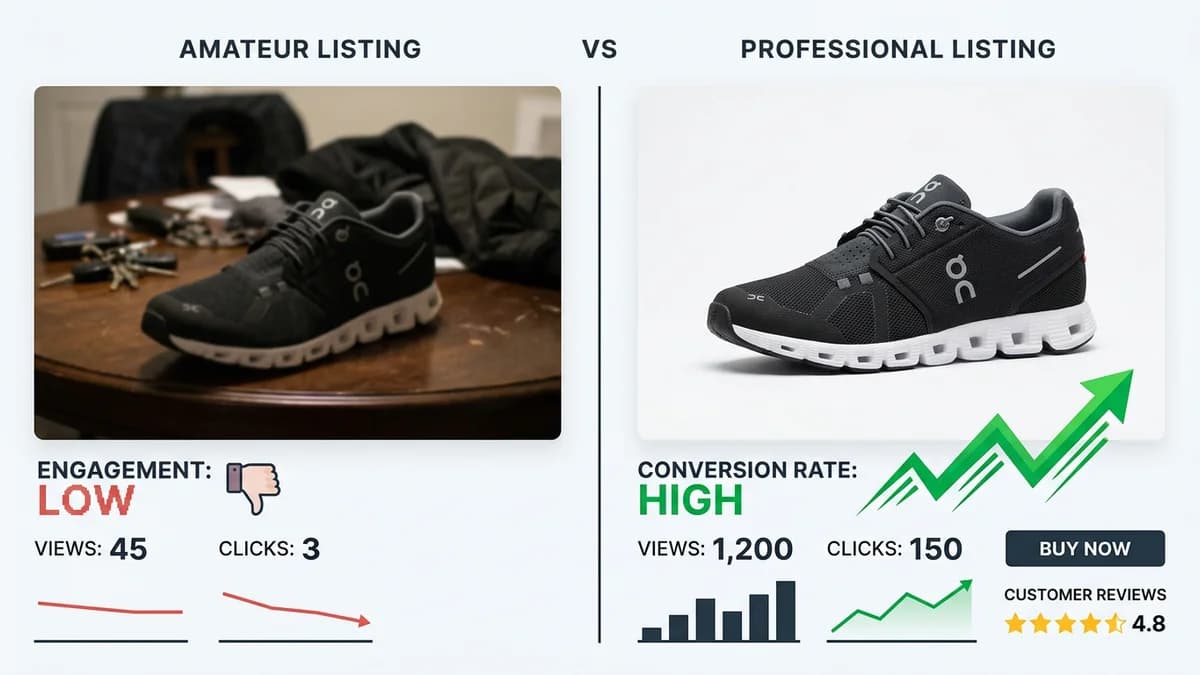
Product photos are the single biggest conversion lever in e-commerce. Upgrading from amateur to professional-quality images increases conversion rates by 20-40%, improves click-through rates by 25-60%, and reduces return rates by 15-25%. On Amazon, listings with all 7-9 image slots filled convert 2-3x higher than listings with fewer than 4 images. The ROI on better product photography is measurable within weeks for any seller with consistent traffic.
Key Takeaways
- Professional-quality product images increase conversion rates by 20-40% compared to amateur photos
- Listings with 7+ images convert 2-3x higher than listings with fewer than 4 images on Amazon
- High-quality product photos reduce return rates by 15-25% because buyers know what to expect
- Mobile shoppers are 3x more likely to bounce from listings with poor images compared to desktop users
- Click-through rates from search results improve 25-60% when the main image is professionally shot
- Adding lifestyle images alongside white background shots increases conversion by an additional 15-30%
The Conversion Rate Data
The question is not whether product photos affect sales. The question is how much.
Multiple studies and platform data sets point to the same conclusion: image quality is the most influential factor in online purchase decisions, ahead of price, reviews, and product descriptions.
What the Numbers Show
A 2025 study by the Baymard Institute analyzing 71,000 product pages found that product images are the first element shoppers interact with on 56% of visits -- before reading the title, checking the price, or scrolling to reviews. When the images were low quality, 42% of shoppers left the page without scrolling.
Shopify's internal data from merchants who A/B tested image quality found:
| Image Change | Average Conversion Lift | |-------------|------------------------| | Amateur photos replaced with professional studio shots | +33% | | White background only replaced with white + lifestyle mix | +22% | | 3 images replaced with 7+ images | +27% | | Low resolution (under 800px) replaced with zoom-enabled (1600px+) | +18% | | Stock photos replaced with actual product photos | +45% |
These are averages across thousands of merchants and product categories. Individual results vary, but the direction is consistent.
Amazon Marketplace Data
Amazon does not publish conversion benchmarks publicly, but seller tools that aggregate data across accounts reveal clear patterns:
Image slot utilization matters. Listings using all 7-9 image slots see a median conversion rate 2.1x higher than listings with 3 or fewer images. The jump from 3 to 5 images alone produces a measurable lift.
Main image quality drives click-through. In Amazon search results, the main image is the primary factor in whether a shopper clicks your listing or your competitor's. Sellers who upgrade their main image to a professional white-background shot report CTR improvements of 25-60%.
Infographic images reduce returns. Listings that include size charts, comparison graphics, or dimension callouts in their secondary images show 15-20% lower return rates.
For the full image specification breakdown, see our Amazon product image requirements guide.
Etsy Marketplace Data
Etsy's own seller handbook states that listings with high-quality photography receive 2-3x more views and favorites than similar listings with poor images. On Etsy, the first image functions as both the search result thumbnail and the hero image, making it disproportionately important.
Etsy's algorithm also factors in click-through rate when ranking listings. Better images lead to higher CTR, which leads to better placement, which leads to more clicks -- a compounding effect.
The Psychology Behind Product Images
Understanding why images drive sales helps you invest in the right improvements.
The "Touch Gap" Problem
In physical retail, customers pick up products, examine them, feel the material, check the weight. Online shopping removes all of that. Product images are the closest substitute for physical inspection.
Research in consumer psychology shows that when shoppers cannot physically touch a product, high-quality images activate similar neural pathways as physical touch. Multiple angles, zoom-enabled detail shots, and lifestyle context images all reduce the "touch gap" and increase purchase confidence.
First Impressions Are Visual
Shoppers form their initial impression of a product in 50 milliseconds -- faster than they can read a single word. That impression is based entirely on the visual. A blurry, poorly lit, or cluttered product image triggers an instant negative judgment that subsequent information (good reviews, competitive price) struggles to overcome.
Cognitive Fluency
Products that are easy to visually process feel more trustworthy. Clean backgrounds, consistent lighting, and sharp focus make products look more professional, which shoppers subconsciously interpret as "this brand is legitimate and this product is high quality." Inconsistent image quality across a listing creates cognitive friction that reduces trust.
Loss Aversion and Returns
Shoppers who cannot clearly see what they are buying experience higher uncertainty. Some buy anyway and return the product when it does not match their mental image. Others simply do not buy. Both outcomes cost you money. Clear, accurate product images reduce both lost sales and returns.
A/B Test Results: Before and After
Here are documented results from sellers who upgraded their product photography while keeping everything else (price, title, description, advertising) constant.
Case: Electronics Accessories Seller (Amazon)
- Before: Phone photos on white poster board, 4 images per listing
- After: AI-generated studio shots + lifestyle images, 8 images per listing
- Results: Conversion rate increased from 8.2% to 12.7% (+55%), return rate decreased from 14% to 9%
Case: Skincare Brand (Shopify)
- Before: Supplier-provided images with inconsistent backgrounds
- After: Professional AI-generated images with branded lifestyle scenes
- Results: Add-to-cart rate increased from 4.1% to 6.3% (+54%), average order value increased by 12%
Case: Kitchen Products Seller (Amazon)
- Before: Studio photos (white background only), 5 images per listing
- After: Same studio photos plus AI-generated lifestyle scenes and infographics, 9 images per listing
- Results: Conversion rate increased from 11% to 14.5% (+32%), CTR from search increased 28%
These results reflect a common pattern: the biggest gains come from two changes. First, improving base image quality. Second, increasing the number and variety of images per listing.
Mobile vs Desktop: Why Images Matter Even More on Phones
More than 70% of e-commerce traffic now comes from mobile devices. On phones, product images occupy a larger percentage of the screen, descriptions require scrolling, and shoppers spend less time reading.
Mobile-Specific Image Impact
| Metric | Desktop Impact | Mobile Impact | |--------|---------------|---------------| | Conversion lift from better images | +20-30% | +30-50% | | Bounce rate with poor images | 25% increase | 45% increase | | Time spent on listing with good images | +40 seconds | +65 seconds | | Swipe-through rate (% who view all images) | 35% | 52% |
Mobile shoppers are more visually driven and more impatient. A product listing with one mediocre image will lose mobile shoppers at nearly double the rate of desktop shoppers.
What This Means for Your Images
- Your main image must be sharp and clear at thumbnail size (150x150px on search results)
- Lifestyle images need to communicate instantly without requiring zoom
- Text on infographic images must be large enough to read on a phone screen
- Image loading speed matters -- optimized file sizes prevent slow-loading pages that cause bounces
Return Rate Correlation
Returns are one of the most expensive problems in e-commerce. Each return costs $10-30 in shipping, handling, and restocking -- not counting the lost sale itself.
How Image Quality Affects Returns
| Return Reason | Percentage of Returns | Image Quality Impact | |---------------|----------------------|---------------------| | "Item not as described" | 22% | Directly caused by poor or misleading images | | "Wrong size/fit" | 18% | Reduced by size reference and dimension images | | "Item looks different in person" | 15% | Reduced by accurate color and multiple angles | | "Did not meet expectations" | 12% | Reduced by detailed, honest product photography |
Over 60% of common return reasons are directly influenced by product image quality. A 15-25% reduction in returns from better images saves $1.50-7.50 per order in return costs.
For a seller processing 500 orders/month with a 15% return rate, reducing returns by 20% (from 75 to 60 returns) saves $150-450 per month in return handling costs alone.
The ROI Math: What Better Photos Are Worth
Let's calculate the return on investment for upgrading product photography.
Scenario: 50-Product Catalog on Amazon
Current performance:
- 50 products, 10,000 total monthly sessions
- 5% conversion rate = 500 orders
- $35 average order value = $17,500 monthly revenue
- 12% return rate = 60 returns
After upgrading images (conservative 25% conversion lift):
- 6.25% conversion rate = 625 orders
- $17,500 + $4,375 = $21,875 monthly revenue
- 9.5% return rate (20% reduction) = 59 returns saved per month at $15 avg return cost = ~$900 saved
Monthly gain: $4,375 + $900 = $5,275
Cost of AI photography for 50 products (7 images each = 350 images):
- Using a Pro-tier AI tool: $30-50/month (see current pricing)
- One-time generation cost: $50-150
The investment pays for itself within the first week.
Even if you use a professional studio at $40/image for 350 images ($14,000), the payback period is under 3 months -- and the improved conversion rate continues generating additional revenue every month thereafter.
The Image Quality Checklist
Not all image improvements are equal. Here is what to prioritize, ranked by impact on conversion:
High Impact (Do These First)
- Fill all available image slots. Going from 3 to 7+ images is the single highest-ROI change on Amazon and Shopify.
- Replace amateur main image with professional white background. The main image drives search CTR. A clean, well-lit, properly cropped main image is non-negotiable.
- Add lifestyle images. Show the product in context -- being used, on a shelf, in a room. This helps shoppers visualize ownership.
Medium Impact (Do These Next)
- Add size reference images. Show the product next to a common object or include dimension callouts. This directly reduces "wrong size" returns.
- Ensure zoom-quality resolution. At least 1600px on the longest side. Shoppers who zoom are high-intent buyers.
- Create consistency across listings. All products should have the same background, lighting style, and image count. Inconsistency signals amateur operation.
Lower Impact (But Still Worth Doing)
- Add infographic images. Feature callouts, comparison charts, and benefit highlights as secondary images.
- Seasonal lifestyle updates. Swap lifestyle backgrounds for holiday or seasonal themes to improve seasonal conversion.
- Optimize for mobile. Verify that all text in images is readable on phone screens.
For a practical guide on how to create these images, see our complete AI product photography guide.
What "Professional Quality" Actually Means
"Professional" does not mean expensive. It means meeting a quality threshold that shoppers perceive as trustworthy. Here is what separates professional-looking images from amateur ones:
| Element | Amateur | Professional | |---------|---------|-------------| | Background | Uneven white, visible creases, shadows | Pure white or intentional lifestyle scene | | Lighting | Harsh shadows, color cast, uneven exposure | Even, soft lighting with natural-looking shadows | | Focus | Slightly soft, especially at edges | Tack sharp across the product | | Composition | Product too small in frame, awkward angles | Product fills 85%+ of frame, natural angles | | Color accuracy | Color shifts from poor white balance | Colors match the physical product | | Consistency | Each image looks different | Uniform style across all product images |
AI photography tools like AIOE produce images that check every box in the "professional" column by default. That is why they have been adopted so rapidly -- not because sellers prefer AI on principle, but because the output meets the quality bar at a fraction of the cost. For a cost breakdown across methods, see our product photography cost comparison.
Frequently Asked Questions
How many product images should I have per listing?
As many as the platform allows. On Amazon, fill all 9 slots. On Shopify, aim for 6-10. On Etsy, use at least 5 of the 10 available. Data consistently shows that more images correlate with higher conversion rates, with the biggest jump occurring between 3 and 7 images.
Do lifestyle images convert better than white background images?
Neither converts better in isolation. The highest-converting listings use both: a clean white background main image (which performs best in search results) plus lifestyle images that show the product in use. The combination outperforms either style alone by 15-30%.
How do I measure the impact of new product photos?
Run a controlled test. Change images on half your listings while keeping the other half unchanged. Compare conversion rates, CTR, and return rates over 2-4 weeks. On Amazon, use the "Manage Your Experiments" tool to A/B test images directly. On Shopify, use your analytics dashboard to compare before/after periods.
Do AI-generated product photos convert as well as studio photos?
For standard product categories (electronics, beauty, home goods, supplements, accessories), A/B tests show no statistically significant difference in conversion rates between AI-generated and studio photography. The important factor is image quality, not the method used to produce it.
How often should I update product photos?
Update images when you notice declining conversion rates, when your product packaging or design changes, or when seasonal opportunities arise. High-performing sellers refresh lifestyle images quarterly to keep listings current. For more on taking your own product shots, read our iPhone product photography guide.
What is the minimum image quality for e-commerce?
At minimum: 1000px on the longest side, accurate colors, sharp focus, clean background, and the product filling at least 75% of the frame. But "minimum" is not a goal -- it is a floor. Listings that merely meet minimum requirements underperform listings that exceed them.