

AI vs Traditional Product Photography Compared
Compare AI and traditional product photography side by side — real costs, turnaround times, quality differences, and when each method works best for sellers.
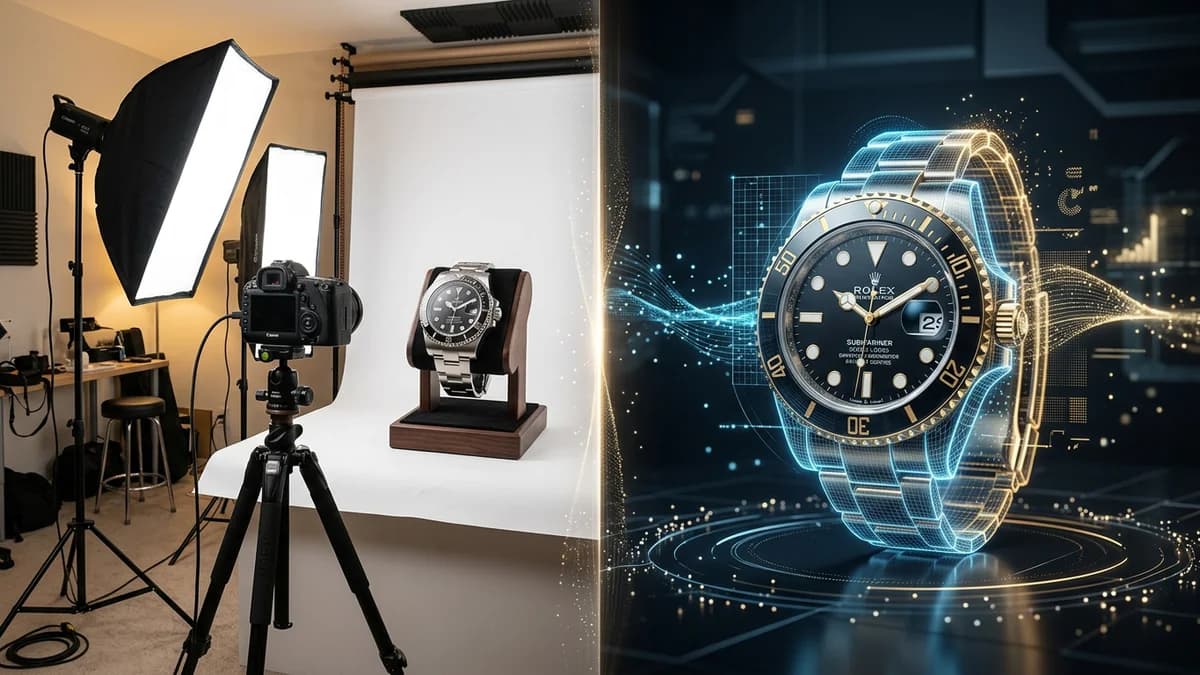
TL;DR
AI product photography costs $0.10--$0.50 per image with results in under 60 seconds. Traditional studio photography costs $25--$75 per image and takes 1--3 weeks from booking to delivery. AI wins on cost, speed, and consistency. Traditional wins for food, on-model apparel, and luxury hero shots. Most sellers get the best results by combining both approaches.
Key Takeaways
- AI photography is 95--99% cheaper per image than traditional studio shoots
- Traditional photography involves hidden costs: setup fees ($500--$2,000), sample shipping ($20--$50 per product), and reshoots
- At 500+ SKUs, AI photography saves tens of thousands of dollars annually
- AI produces more consistent results across large catalogs -- same lighting, same angles, same style
- Traditional photography still delivers superior results for food, beverages, on-model clothing, and ultra-premium branding
- A hybrid approach (AI for catalog images, traditional for hero shots) gives the best cost-to-quality ratio
The Real Cost of Traditional Product Photography
Most cost comparisons only quote the per-image rate. That number is misleading. Traditional product photography has several cost layers that add up fast.
Studio and Setup Fees
Before a single photo is taken, you are paying for:
- Studio rental: $200--$500 per half-day session
- Photographer fee: $300--$1,500 per session depending on experience and market
- Setup and styling: $100--$500 for props, backgrounds, and product arrangement
- Post-production: $5--$25 per image for retouching, color correction, and background removal
A typical half-day shoot covers 10--20 products. That puts your all-in setup cost at $500--$2,000 before counting individual image costs.
Shipping and Sample Costs
If you work with a remote studio (most sellers do), you also pay:
- Sample shipping: $20--$50 per product (outbound + return)
- Sample damage risk: Products get lost or damaged in transit. Replacement costs add up.
- International shipping: $40--$100+ per product if your studio is overseas
For a catalog of 100 products, shipping alone costs $2,000--$5,000.
The Per-Image Cost
Once setup is done, the actual per-image cost ranges from $25--$75 depending on complexity:
| Image Type | Typical Cost | |-----------|-------------| | White background (standard) | $25--$40 | | Lifestyle / in-context | $40--$60 | | Flatlay composition | $35--$55 | | Close-up / detail shot | $30--$50 | | Model photography | $60--$150+ |
These rates assume an established studio. Freelance photographers in major cities like New York or London often charge more.
The Real Cost of AI Product Photography
AI product photography has a much simpler cost structure. There are no setup fees, no shipping, and no minimum orders.
Per-Image Pricing
Most AI photography tools charge based on image resolution and generation count:
| Resolution | Typical Cost | |-----------|-------------| | 1K (standard web) | $0.10--$0.20 | | 2K (marketplace-ready) | $0.20--$0.35 | | 4K (print/zoom) | $0.35--$0.50 |
What You Do Not Pay For
- No studio rental
- No photographer hourly rate
- No props or styling materials
- No sample shipping (works from a photo or URL)
- No minimum order quantity
- No reshoot costs (regenerate unlimited times)
The total cost is the per-image price. Nothing else. See AIOE pricing for a detailed breakdown of credit costs by resolution.
Side-by-Side Cost Scenarios
Here is what both approaches cost at different catalog sizes. These numbers assume 2K resolution AI images and mid-range traditional studio rates ($35/image average, $1,000 setup per session).
| Scenario | Traditional Cost | AI Cost | Savings with AI | |----------|-----------------|---------|----------------| | 10 products, 5 images each (50 images) | $2,750 ($1,000 setup + $1,750 images) | $15 | 99.5% | | 50 products, 5 images each (250 images) | $9,750 ($1,000 setup + $8,750 images) | $75 | 99.2% | | 100 products, 5 images each (500 images) | $19,500 ($2,000 setup + $17,500 images) | $150 | 99.2% | | 500 products, 7 images each (3,500 images) | $126,500 ($4,000 setup + $122,500 images) | $1,050 | 99.2% | | 1,000 products, 7 images each (7,000 images) | $249,000 ($4,000 setup + $245,000 images) | $2,100 | 99.2% |
The numbers speak for themselves. At 50 images the difference is meaningful. At 3,500 images it becomes the difference between a major budget line item and a rounding error.
For the traditional estimates, note that the setup cost assumes you need multiple sessions as your catalog grows. A single half-day session cannot cover 500 products. You would need 25--50 sessions, pushing setup costs much higher than shown here.
Turnaround Time Comparison
Cost is only half the equation. Time matters just as much -- especially when you are launching new products or running seasonal campaigns.
Traditional Photography Timeline
| Stage | Time | |-------|------| | Finding and booking a photographer | 1--5 days | | Shipping samples to the studio | 2--7 days | | Shoot day | 1 day | | Post-production and retouching | 3--7 days | | Revisions (if needed) | 2--5 days | | Total | 1--3 weeks |
And that timeline assumes no delays. In peak season (Q4 for e-commerce), photographers are booked weeks in advance. Your 1--3 week timeline can easily stretch to 4--6 weeks.
AI Photography Timeline
| Stage | Time | |-------|------| | Upload product image | 30 seconds | | Select style and settings | 30 seconds | | AI generates image | 30--60 seconds | | Total | Under 2 minutes |
Need 50 images in different styles? You can have all 50 done in under an hour. With batch processing, you can generate hundreds of images while you focus on other tasks.
Quality Comparison: An Honest Assessment
This is where the conversation gets nuanced. AI photography is not universally better or worse than traditional photography. Each approach has clear strengths.
Where AI Delivers Equal or Better Quality
White background product shots -- AI generates flawless pure white backgrounds every time. No uneven lighting, no shadow bleed, no off-white tones. This is where AI is genuinely hard to beat.
Consistency across SKUs -- When you photograph 200 products in a traditional studio, lighting shifts throughout the day. The photographer adjusts, but variations creep in. AI generates every image with identical lighting, angles, and composition. Your product catalog looks uniform.
Lifestyle scene variety -- Want to see your product on a marble countertop, a rustic wooden table, and in a minimalist bathroom? AI generates all three for pennies. A traditional shoot would require three different sets.
Seasonal and thematic images -- Holiday themes, summer backgrounds, Valentine's Day styling -- AI can swap contexts instantly without rebuilding a physical set.
Where Traditional Photography Still Wins
Food and beverage -- Steam rising from coffee, condensation on a cold bottle, the texture of frosting on a cake. AI has improved dramatically, but food photography relies on physical details that generative models still struggle with at a professional level.
Apparel on human models -- Fabric drape, fit, and movement on a real human body communicate information that AI cannot fully replicate. If you sell clothing or accessories, you likely need at least some model photography.
Luxury and premium branding -- Ultra-high-end brands (jewelry, watches, premium spirits) often need hero images with a specific artistic vision. A skilled photographer controlling every light and shadow can achieve a level of intentionality that AI cannot match yet.
Complex multi-product setups -- Gift baskets, bundled products, or elaborate tablescapes with many items arranged precisely. AI handles single products well but can struggle with complex compositions involving many distinct items.
The Quality Gap Is Closing
It is worth noting that AI image quality improves measurably every few months. What was impossible for AI a year ago (realistic reflections, accurate shadows, material textures) is now standard. The categories where traditional photography holds an advantage are narrowing.
Scalability: What Happens at 5,000 SKUs
Scalability is where AI photography becomes not just cost-effective but operationally necessary.
Traditional Photography at Scale
A studio photographing 5,000 SKUs at 5 images each needs to produce 25,000 images. At a rate of 20 products per day, that requires 250 shooting days -- nearly a full year of continuous work. You would need multiple photographers working in parallel, which introduces consistency problems across different shooters, studios, and lighting setups.
Adding new products means coordinating another session. Updating seasonal images means reshooting. Refreshing your catalog look means starting over.
AI Photography at Scale
The same 25,000 images can be generated in days, not months. Adding new products takes minutes. Updating seasonal images is a batch operation. Refreshing your entire catalog style is a single settings change applied to all products. Try AIOE free to see how batch generation works at scale.
For businesses with large or frequently changing catalogs -- dropshipping stores, print-on-demand brands, wholesalers with thousands of SKUs -- AI photography is the only practical option.
When to Use Each Approach: A Decision Framework
Use this framework to decide which approach fits each product in your catalog.
Choose AI Photography When
- You have more than 20 products needing images
- You need white background or standard lifestyle shots
- Speed to market matters (new launches, seasonal updates)
- Your budget is limited relative to your catalog size
- You need to test multiple image styles before committing
- You sell hard goods: bottles, boxes, electronics, accessories, home goods, cosmetics packaging
Choose Traditional Photography When
- You sell food or beverages where texture and freshness matter
- You need on-model apparel photography
- You are building a luxury brand where every hero image must be art-directed
- You have fewer than 10 products and need one definitive set of images
- Your products require complex multi-item arrangements
Choose Both (Hybrid Approach)
For most e-commerce businesses, the smartest strategy combines both approaches:
- AI for catalog images: White backgrounds, standard lifestyle shots, marketplace main images, secondary listing images, and seasonal variants. This covers 80--90% of your image needs at minimal cost.
- Traditional for hero shots: Homepage banners, ad creatives, brand story images, and flagship product photography. These are the images that define your brand -- invest in them.
- AI for testing, traditional for finals: Use AI to rapidly prototype different styles and compositions. Once you identify what works best, commission a traditional shoot for the final hero versions.
This hybrid model gives you the speed and cost efficiency of AI for your daily operations while preserving the creative control of traditional photography for the images that matter most.
Marketplace Acceptance and Compliance
A common concern: will Amazon, Shopify, or Etsy reject AI-generated images?
The short answer is no. Marketplaces evaluate images on technical quality, not generation method. For the full breakdown, read our Amazon AI product photo policy guide.
Amazon requires a pure white background (RGB 255,255,255) for main images, minimum 1000px on the longest side, and no added text or graphics. AI tools generate images that meet all of these requirements reliably. See our complete Amazon image requirements guide for every specification.
Shopify and standalone e-commerce stores have no restrictions on how images are created.
Etsy is the most permissive -- they allow lifestyle and creative photography in any style.
Frequently Asked Questions
Is AI product photography good enough for professional use?
Yes. AI-generated product images are used by thousands of e-commerce sellers on Amazon, Shopify, Etsy, and other platforms. Image quality from current AI models is indistinguishable from studio photography for most product categories, particularly hard goods like cosmetics, electronics, accessories, and home products. The key is starting with a clear reference image of your product.
Can customers tell the difference between AI and traditionally photographed products?
In most cases, no. Modern AI photography produces images with accurate shadows, reflections, and lighting that match real-world physics. In blind tests, consumers consistently rate AI-generated product images as equally professional to studio-shot equivalents. The exceptions are product categories where physical nuance matters -- food texture, fabric drape on models, and extreme close-up material details.
How much can I save switching from traditional to AI photography?
For a typical e-commerce catalog of 100 products needing 5 images each, you would spend $15,000--$25,000 on traditional photography versus $100--$250 on AI. That is a savings of 99%+. Even accounting for a handful of traditional hero shots in a hybrid model, most businesses save 85--95% on their total photography budget.
What about product images with multiple angles?
AI tools can generate different angles (front, side, top-down, three-quarter) from a single reference image. The AI understands the product's 3D form and renders it convincingly from various perspectives. For best results, provide a clear reference image with good lighting, and the AI handles angle variations.
Do I need to disclose that my product images are AI-generated?
No major marketplace or e-commerce platform requires disclosure of AI-generated product images. The regulatory landscape may evolve, but as of 2026 there is no legal requirement to label AI-generated commercial product photography in the US, EU, or UK. The images must accurately represent the product you are selling -- this applies equally to traditional and AI photography.
What file formats and resolutions does AI photography support?
Most AI photography tools output images in standard web formats (JPEG, PNG, WebP) at resolutions from 1K to 4K. This covers every major marketplace requirement. Amazon's recommended 1600px+ for zoom functionality is well within range. High-resolution outputs also work for print catalogs and packaging if needed.
Can I use AI photography for Amazon A+ Content and brand stores?
Absolutely. AI is particularly effective for A+ Content because you need multiple lifestyle and comparison images per product. Generating a full set of A+ Content images (typically 5--7 per product) costs under $2 with AI versus $200--$500 with traditional photography. The consistent style also gives your brand store a more cohesive look.